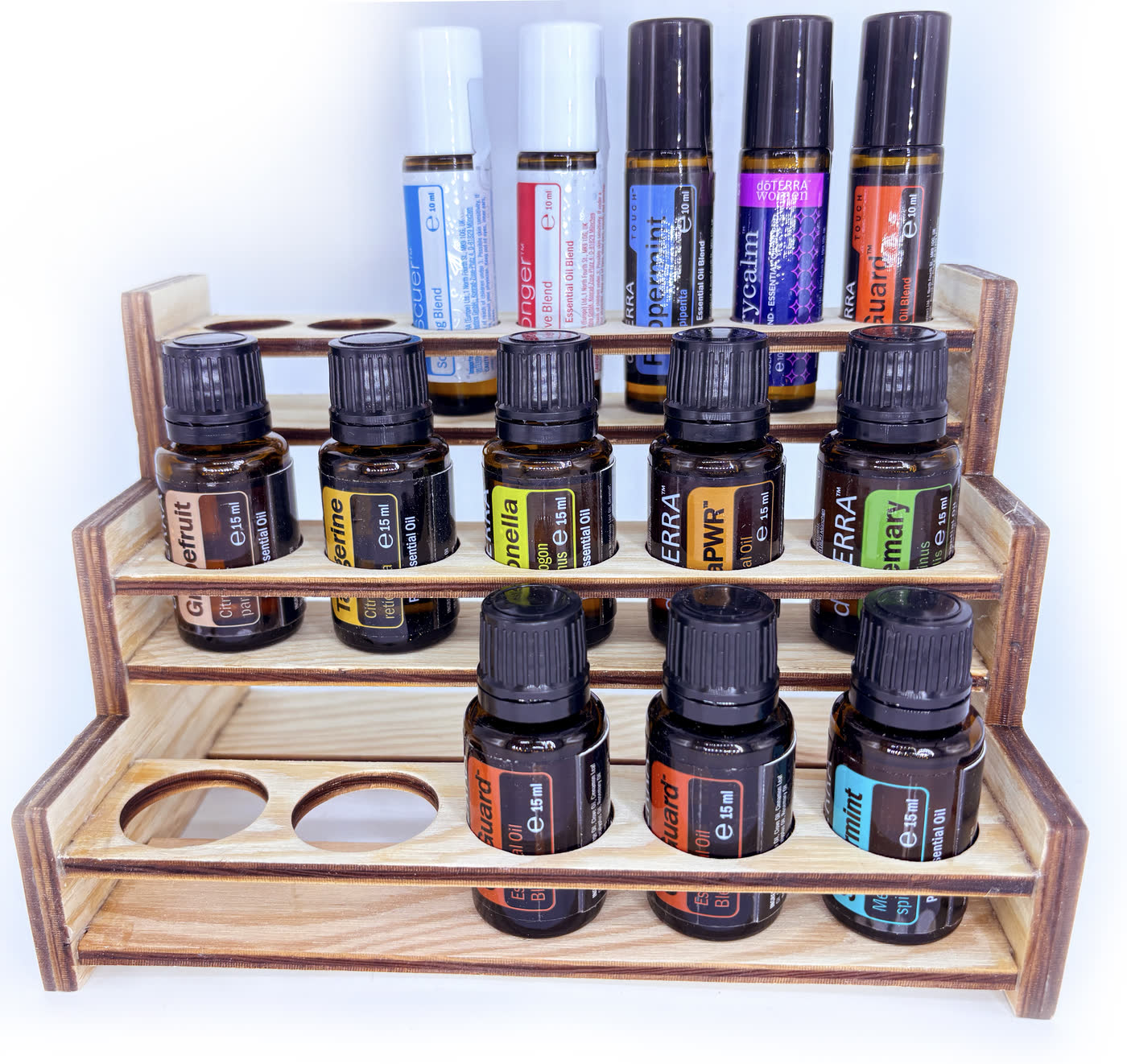
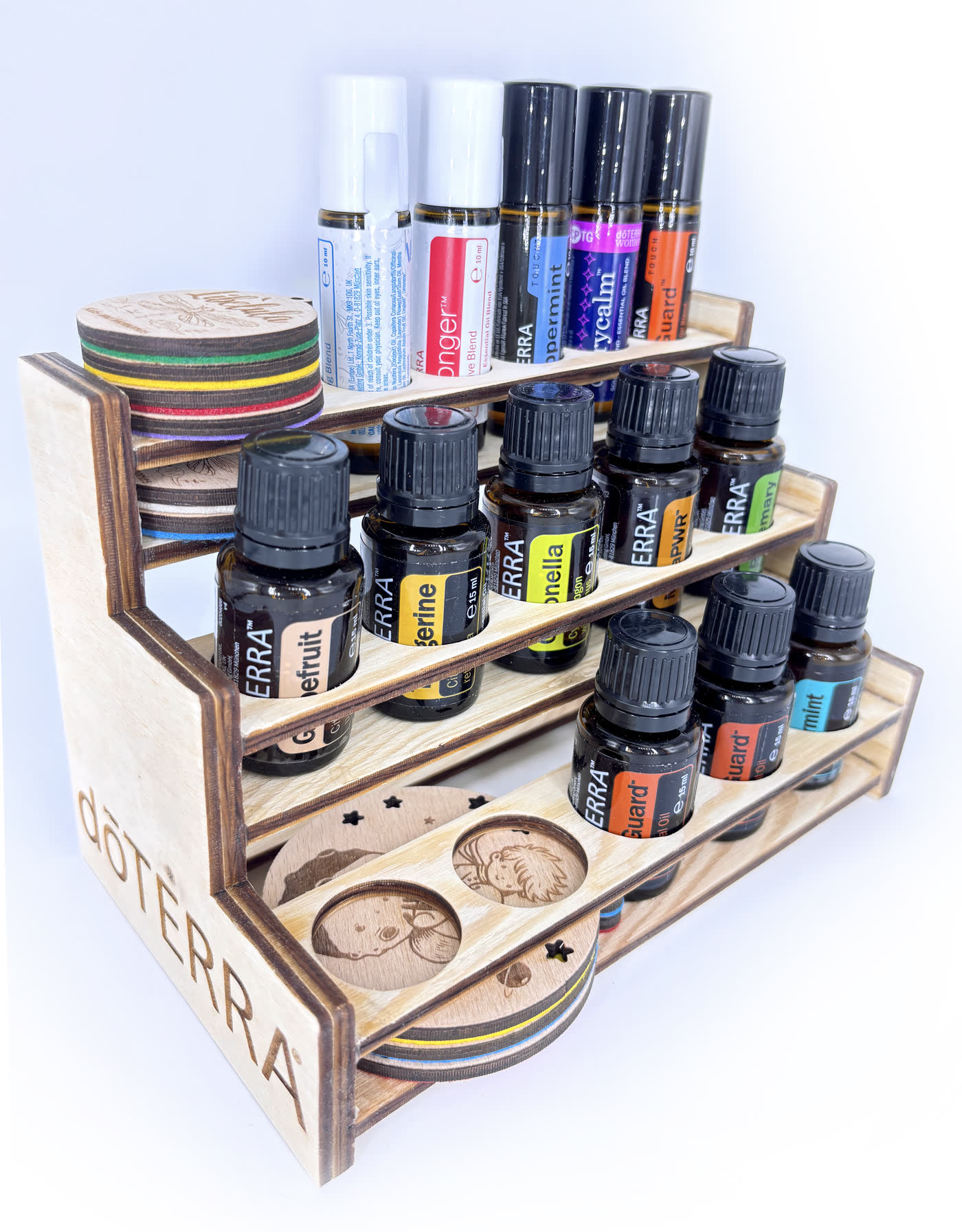
This is a stepped wooden rack whose holes are cut to the exact outside diameter of the bottles it carries — roller bottles in one row, 15 ml bottles in another, larger ones at the back — with the brand's wordmark engraved into the front panel. It is made for people who present a single product line: at a market, at a home presentation, on a shelf in a treatment room.
Anyone selling essential oils, supplements or small cosmetics owns a box. The bottles travel in the box, come out onto a table, stand around in a loose group, and go back in the box. It works, and it looks exactly like what it is.
What was asked for here was the opposite of a box: something that presents the range rather than transports it.
What a display is actually for
It is worth being precise about this, because it changes what you should order.
A display is not storage. Storage keeps things safe and out of the way; a display makes a customer pick something up. Those are opposite requirements — storage wants everything enclosed and protected, a display wants everything reachable and slightly exposed. A box that you open at a market is storage that has been asked to do a display's job, which is why it never quite works.
The test is simple and you can run it on whatever you use now. Stand two metres away, as a customer would. Can you read what is in front of you? Can you tell how many different things there are? Would you know which one to pick up first? If the answer to any of those is no, the object is storage, however nice it is.
The problem with a generic organiser
Buy a wooden bottle stand from a shop and the holes are a compromise. They have to take a 10 ml bottle and a 15 ml bottle and a roller and a dropper, so they are cut to the largest of those, and everything smaller sits loose in its hole.
A loose bottle leans. A leaning bottle turns, so the label faces away. Ten leaning bottles with their labels at ten different angles is what most displays actually look like, and it is not a detail nobody notices — it is the first thing a customer sees.
When the hole matches the bottle, the bottle stands up straight and stays where it was put. Everything downstream of that — the labels lining up, the row looking deliberate, a bottle lifting out cleanly instead of dragging its neighbours — follows from one measurement.
What we measure
Not the volume printed on the bottle. The outside diameter of the glass at its widest point, and the diameter of the cap, because on some bottles the cap is wider than the body and it is the cap that decides whether the bottle drops in.
On this rack there are three different hole sizes, because the range has three bottle formats. The rollers are narrow and tall; the 15 ml bottles are wider; the largest sit at the back where their height does not hide anything. A single hole size would have meant the rollers rattling in holes cut for the big ones.
If you want one of these, the useful thing to send is not a product list — it is one bottle of each format, or a photograph of each standing next to a ruler. We would rather measure than interpret a specification.
Why it is stepped
Because a flat rack shows you the front row and the shoulders of everything behind it.
Each tier here sits higher than the one in front, by enough that the label on the back row is readable over the caps of the middle row. That is the whole reason for the shape: a display exists so that someone can read what is on it without picking anything up.
The steps also do something less obvious. They make the whole object read as a single piece of furniture rather than as a tray with things in it, which is the difference between a stand that looks professional on a market table and one that looks like storage.
The wordmark on the front — and whose it is
The front panel carries the brand's wordmark, engraved into the wood in the same pass as the rest of the piece.
We should be plain about this, because it matters and most workshops will not raise it: that wordmark is not ours and it is not yours either. It belongs to the brand. We engrave it because the person ordering the rack represents that brand and has the right to use its marks — and it is the customer's responsibility to have that right, not ours to assume it.
If you are an authorised consultant, distributor or stockist, this is straightforward and nobody will mind. If you are not, ask the brand first. We will make you a beautiful rack with no wordmark on it at all, and it will hold exactly the same bottles.
The discs in the bottom row
The lowest tier has round recesses, and in them sit engraved wooden discs with botanical illustrations — the plant each oil comes from.
They serve two purposes and one of them is practical. As objects, they let a customer connect a bottle to a plant without reading anything, which is most of what a display is trying to do. As markers, they can be lifted out and put beside a bottle on the table during a presentation, so the thing being talked about is physically singled out.
They are also the part people pick up, which is worth knowing: a display where something is meant to be handled gets handled, and a customer holding a piece of your display is a customer standing at your table.
The tier nobody thinks about: the front edge
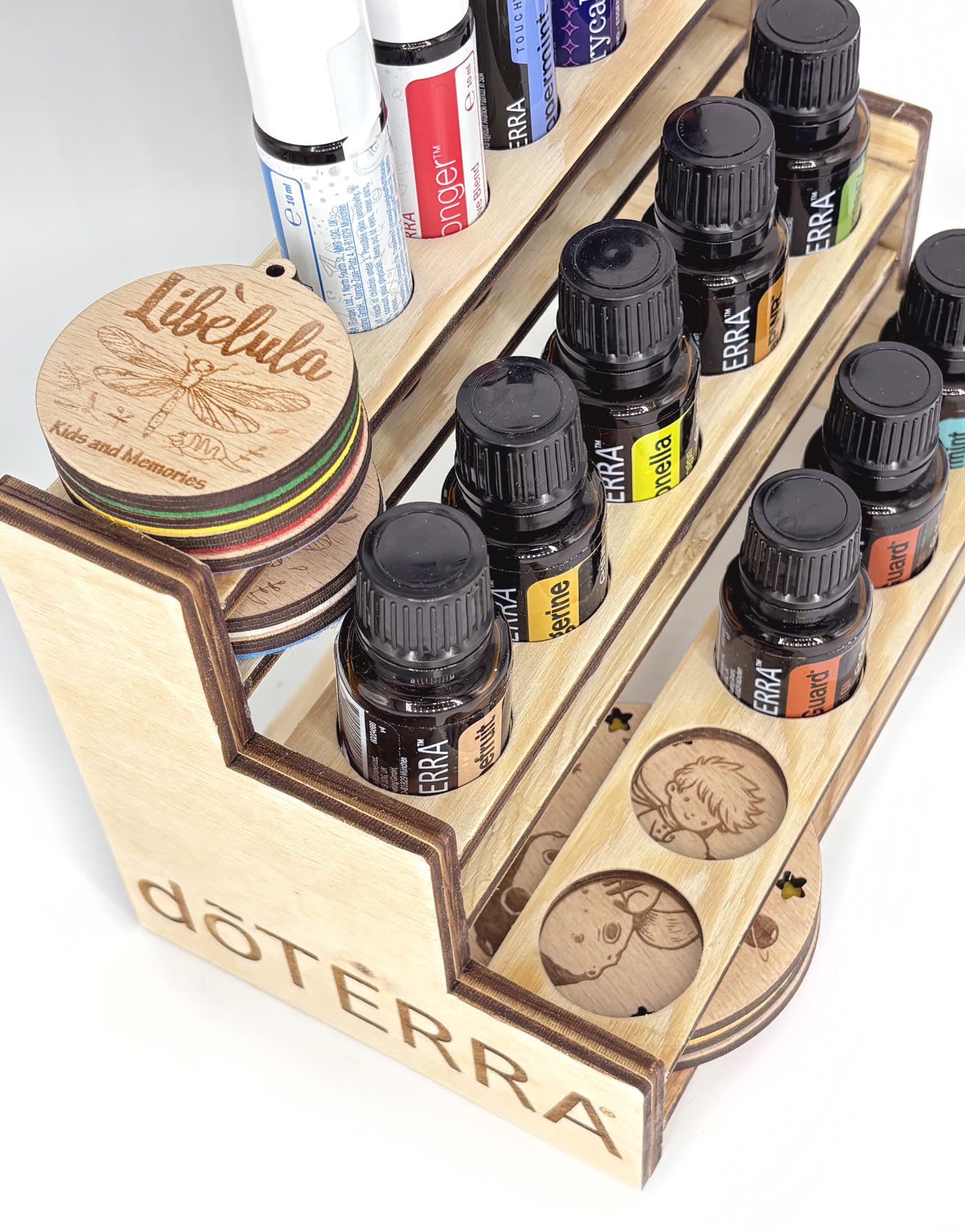
The lowest, nearest strip of a stepped rack is the one people underestimate, and it is the piece of real estate a customer's eye actually lands on first.
On this rack it carries the wordmark and the botanical discs. It could equally carry a price, a QR code to an order page, a short line about what the range is, or nothing at all — a clean strip of wood in front of a full rack is not wasted space, it is what stops the display looking crowded.
What we would not do is fill it with text. The whole object is working on the assumption that someone reads it from two metres and then walks over; a paragraph at the front is a paragraph nobody at two metres can see, taking up the room that made the rest legible.
What it is like to carry
This is the part that decides whether a display gets used, and it is usually the part nobody asks about before ordering.
A rack that lives on one shelf can be any shape. A rack that goes to a market every second Saturday has to survive a car boot, a folding table and a person carrying it with one hand while holding a box with the other. Plywood is forgiving about that in a way that thin solid timber is not, and the stepped construction is rigid because each tier braces the ones beside it.
What we would ask you before cutting: does it travel? If it does, we would rather add a millimetre of thickness and a wider foot than build you something elegant that arrives at its third market with a cracked corner.
Made for one line, not for a category
The reason we are writing about a rack for essential oils rather than a rack in general is that the specificity is the product.
The same construction — stepped tiers, holes cut to a measured diameter, a wordmark on the front, recesses for something that lifts out — works for nail polish, for supplement bottles, for tester vials in a pharmacy, for miniature spirits at a tasting, for paint pots in a craft shop. In every one of those cases the useful version is cut to the bottle that business actually sells, and the useless version is the one that fits everything.
So the question we ask first is never "what kind of rack do you want". It is "what is standing on your table right now, and what is wrong with how it looks".
Questions we get
Can you make it hold a different number of bottles?
Yes — the layout is a drawing, so twelve holes or thirty is a change to the file rather than a different product. Tell us how many of each format you carry and whether the range is likely to grow, because it is cheaper to cut a rack with two empty holes now than a second rack in a year.
What if my bottles change?
Then the holes are wrong, and that is the honest downside of something cut to measure. It is worth asking your supplier whether a format change is coming before ordering a rack for fifty bottles. If one row changes, that row can sometimes be recut rather than the whole piece.
Can I have my own name on it instead of the brand's?
Yes, and for a lot of consultants it is the better choice: the brand is on every bottle already, and the thing a customer needs to remember is who you are. Your name, your phone number, or both — engraved into the same panel, in the same pass.
Is it finished, or bare wood?
Bare and hand-sanded. If it is going into a treatment room or onto a market table where oil gets spilled, say so — an oiled or sealed finish resists a spill far better than raw wood, and it is a decision that should be made before cutting rather than discovered afterwards.
Can you make a smaller one for a treatment room?
Yes, and it is a different design rather than the same one shrunk. A rack that lives on a shelf behind a therapist does not need to survive a car boot and does not need to be read from two metres — so it can be lighter, lower and hold the six oils actually in use rather than the whole range.
What happens if a bottle breaks on it?
Bare wood absorbs, so a spilled oil will leave a mark and, with the stronger citrus oils, a smell that stays. This is the strongest argument for a sealed finish if the rack is going anywhere oil is opened. Tell us where it will live and we will tell you which we would build.
Does it come apart for transport?
Ask when you order. A rack that never moves is better built as one rigid piece; one that travels every fortnight is better built to come apart, and those are different drawings. We will build whichever you actually need if you tell us which it is.
How many can you make?
Our own workshop runs to around 10 000 pieces a month, and a rack is several pieces, so a run for a team of consultants is comfortably within that. For a national distributor ordering hundreds, ask — we work with two partner workshops and can take considerably more than we can cut alone.
What to send us
One bottle of each format, or a photograph of each beside a ruler. Your logo or the brand's wordmark as a file. Roughly how many bottles the rack should hold, and whether it travels.
We draw it, cut one, and you see the real object with your own bottles in it before a run is made. Cut, sanded and engraved in our own workshop in Gemer, Slovakia.
Ready to send one?
Choose a ready-made box or build your own — engraved with your logo or a name.