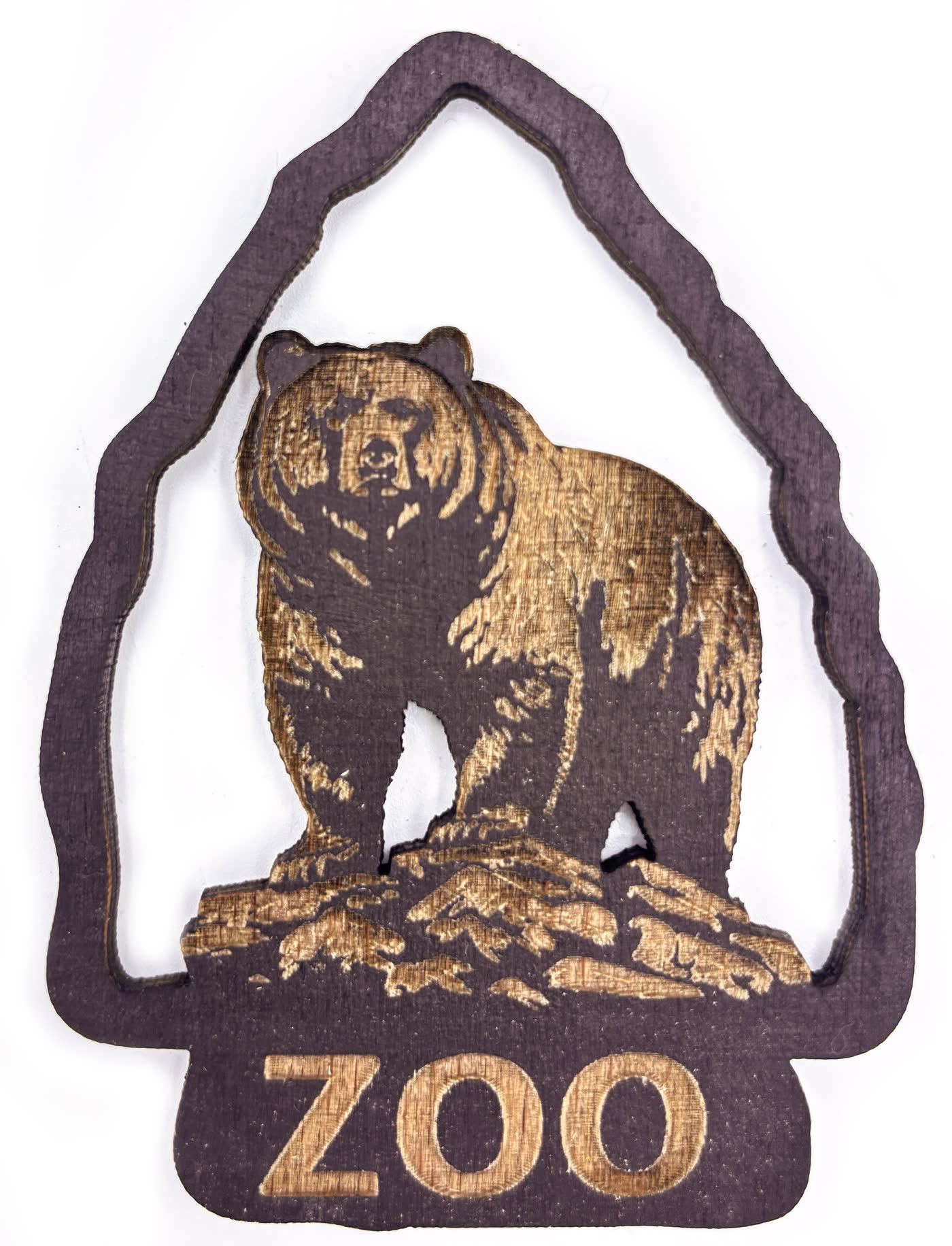
A wooden souvenir medallion is a laser-cut plaque with the subject engraved in relief — raised out of a darker background rather than scratched into a flat surface — and the attraction's own name cut into the same piece. They are made in runs of a few hundred rather than a few thousand, which is what makes them practical for a zoo, a park or a heritage railway.
Every visitor attraction has a gift shop, and almost every gift shop has the same problem. The souvenirs that are cheap enough to sell at the exit are made a continent away in quantities that have nothing to do with your visitor numbers, and they say almost nothing about the place the visitor has just spent three hours in.
We make the other kind. Not more expensive by much — but made here, in the quantity you actually need, with your name on it.
What relief engraving actually means
Most engraved wood you have seen is a line drawing burnt into a flat surface. It reads at arm's length and disappears at two metres.
Relief is different work. The laser removes the background in passes of varying depth, so the animal is left standing proud of the wood around it, with real shadow in the recesses. A bear's shoulder is higher than its flank; the fur is a texture rather than a set of scratched lines. The whole subject catches light from the side, which is why it still reads when it is hanging on a Christmas tree across a room.
That depth is also why these hold up as souvenirs. There is no ink and no transfer to wear off — if the surface scuffs, what is underneath is the same picture.
The two-tone trick, and why it is not paint
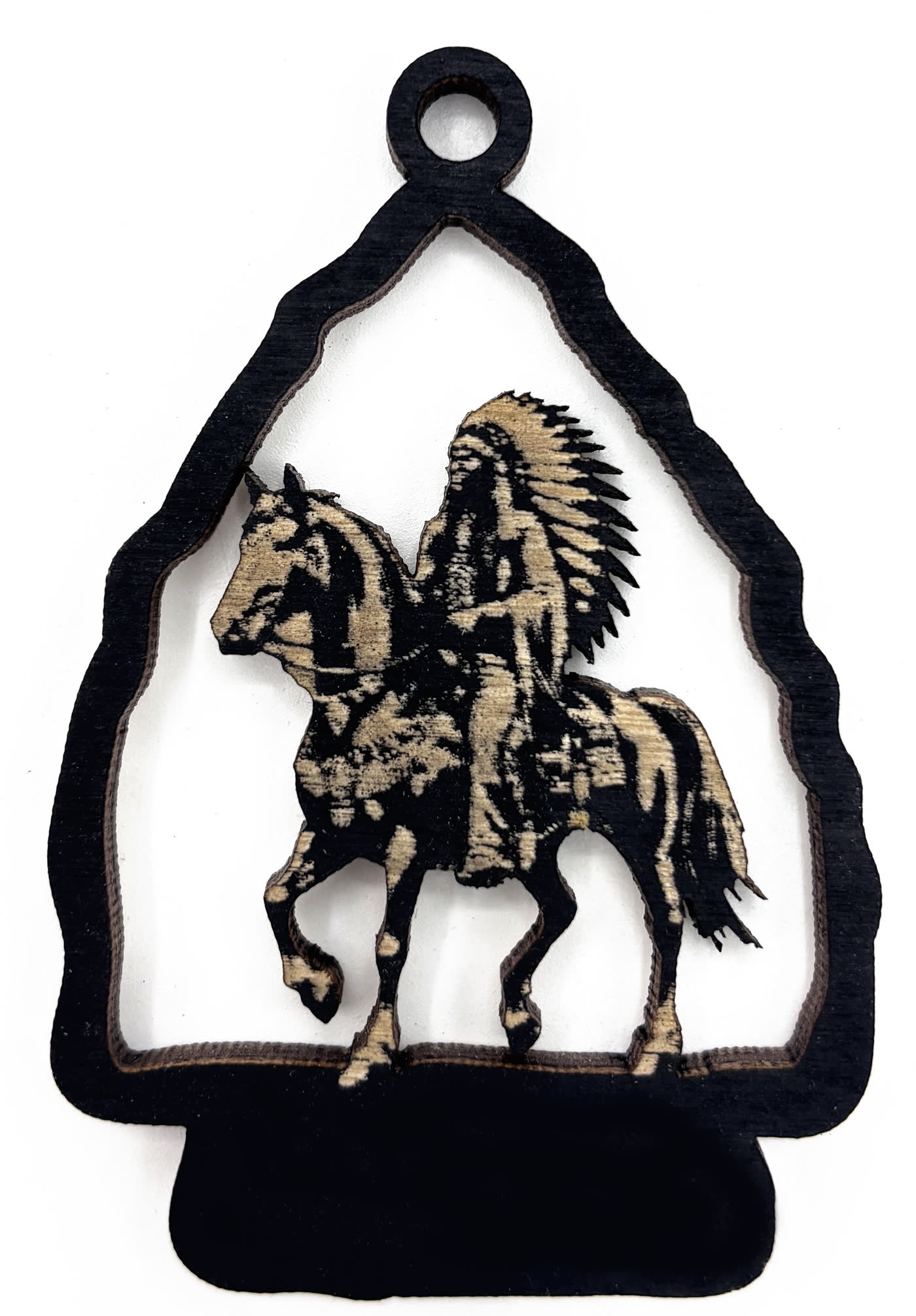
Look at the darker examples and you will see a black or deep-brown border with a pale subject inside it. That is not a painted frame.
The sheet is stained through before cutting, so the surface is dark and the layers underneath are not. The laser then cuts down through the stained face into clean wood, and the depth of each pass decides how light that area comes out. The contrast you are looking at is a section through the material, not a coating on top of it.
Practically, that means the two tones cannot separate, chip or peel, and a scratch does not reveal a different colour underneath — it reveals more of the same wood.
A real example: the children's railway
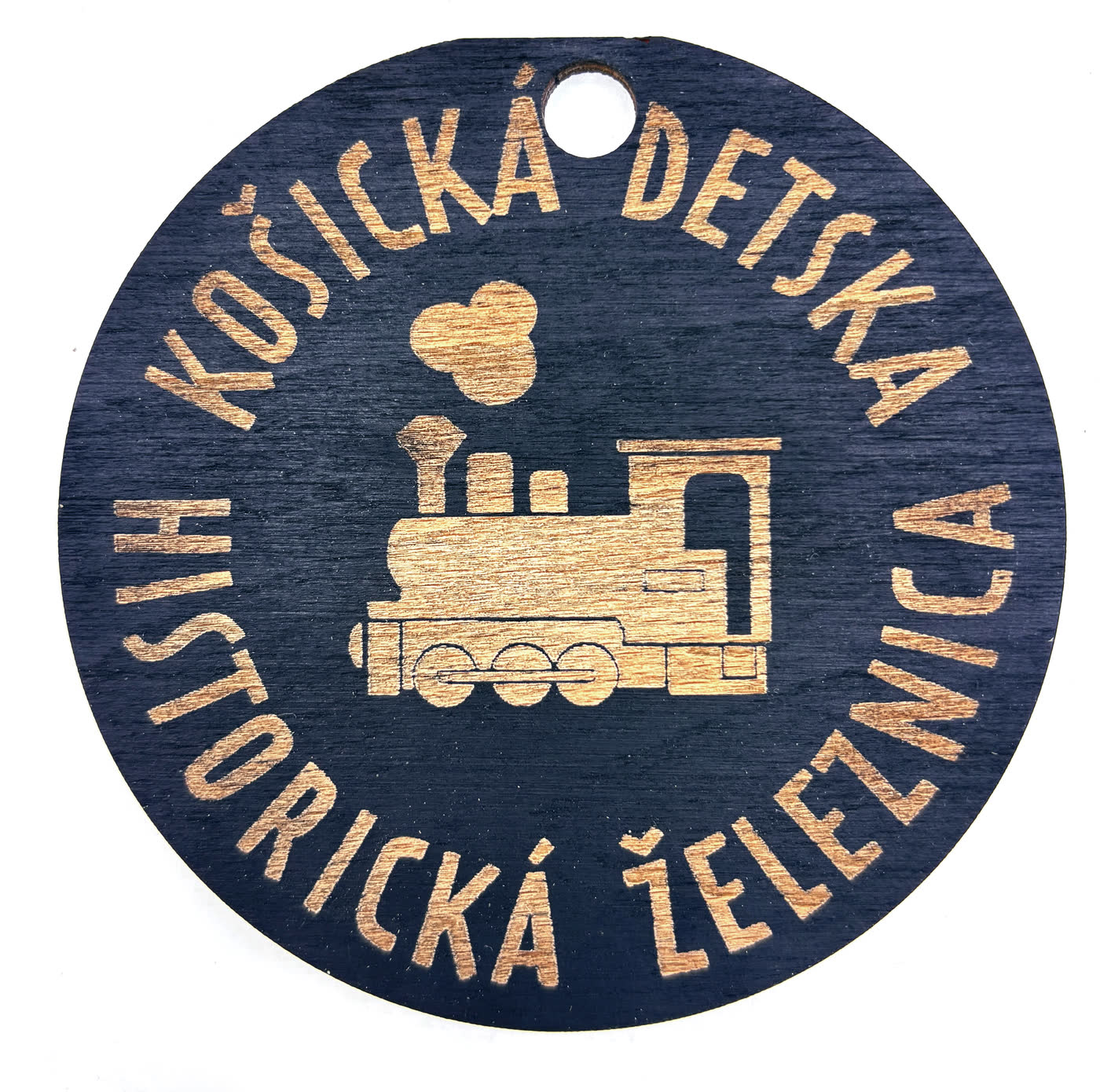
The Košice Children's Historical Railway is a narrow-gauge line run largely by children — a genuinely unusual attraction with a genuinely specific identity. A generic wooden train would have been worse than nothing.
What it got was a round tag with its own locomotive on it, its full name running around the rim, and a hole at the top so it goes straight onto a keyring, a rucksack or a tree. The subject is drawn from the actual engine the children ride, not from a stock illustration of a train.
That is the part that decides whether a souvenir works: whether the visitor recognises the thing they just did. A bear is a bear anywhere. Your bear, with your name under it, is the one they keep.
The arithmetic from your side of the counter
This is the part that decides it, and it is worth doing with your own numbers rather than an average.
You are reselling. Unlike almost everything else we make, these are not bought to be given away — they are bought to be sold again at the exit. So the number that matters is not the unit price, it is the gap between what you pay and what a visitor will hand over for the thing they are holding.
Wood sells for more than plastic. Not because of the material cost, which is trivial either way, but because of what the object appears to be. A parent who will not spend money on a moulded keyring will spend it on something that looks made.
Small runs change the risk. The reason gift shops are full of the same things is that the minimum order is enormous, so nobody can afford to try a design that might not sell. When the run is a few hundred, a design that does not work costs a few hundred — and one that does can be reordered the same month.
Reordering is the whole point
Once a design is drawn and cut once, the second run is much less work than the first. The file exists, the settings are known, and the only real question is how many.
That changes how a shop can be run. Instead of ordering a year of stock in one go and living with it, you can order a season, see what moved, and put the money into the two designs that sold rather than the six that did not. It also means a temporary exhibition can have its own souvenir without committing to a container of them.
We keep the files. If you come back in eighteen months for the same fox, it is the same fox.
What subjects work
The animals people came to see. Not the whole collection — the two or three that are on your posters. Visitors buy the thing they photographed.
The building, the vehicle, the landmark. A castle, a locomotive, a lookout tower. Anything with a recognisable silhouette relief-engraves beautifully, because the depth does the work that colour would otherwise have to do.
The thing only your visitors know about. The oldest tree, the resident who has a name, the bench with the story. These are the ones that outsell the obvious subjects, because they are proof you were there rather than proof the place exists.
Weight is an argument you do not have to make
The thickness of the sheet is the single decision that changes how a souvenir feels, and it is the one most people never think about.
A thin piece is lighter, cheaper and reads as a token. A thicker one has heft in the hand, the relief has somewhere to go, and the edge itself becomes visible — you can see that it is a solid piece of material rather than a veneer. Nobody at the till articulates this. They pick two things up, put one down, and buy the other.
The trade is real, though, and it is not only cost. A thicker sheet takes longer to cut, and on a hanging ornament the extra weight is felt by the branch. We will tell you which thickness we would use for the format you have chosen, and why — and if you disagree, we will cut you one of each and let the object argue for itself.
How they sit on the counter
A souvenir that is excellent in the hand can still fail on the counter, because nobody picks it up.
Three things fix that, and none of them costs much. Hang them. A tag with a hole is designed to be seen edge-on from across a shop; in a bowl it is a pile of wood. Show one open. One piece out of its bag, on a small stand, gets handled — and handling is the entire sale for an object whose whole argument is how it feels. Put the name where the eye lands. If your attraction's name is on the back, the visitor never learns that this is specific to where they are standing.
We can make the stand out of the same sheet, cut at the same time, for very little. It is usually the cheapest part of the order and the one that decides how the rest of it performs.
Photographs, engraved
The same machine will put a photograph into wood — a real one, with tone rather than outline. It works best on subjects with strong light and a simple background, and it is the option for a commemorative piece rather than a shop item: an anniversary, a retirement, a plaque for a donor.
Send the largest file you have. A photograph that looks fine on a phone often has nothing left in the shadows once it is a physical object, and we will tell you before cutting rather than after.
Formats that work at the till
Keyring or hanging tag. The one that sells. Hole at the top, small enough to be an impulse, sturdy enough to survive a rucksack.
Fridge magnet. The same face with a magnet recessed into the back, so the surface stays flush.
Standing medallion. A slightly larger piece with a slot-in foot, for people who want the thing on a shelf rather than on a key.
Christmas ornament. Seasonal, and the format where relief engraving earns its keep — it is the one souvenir that comes out of a box once a year and gets looked at properly.
What we need from you
Your logo or wordmark as a file, a photograph or drawing of each subject, and a rough number. That is genuinely all: we prepare the drawing, cut a sample, and you see the real object before the run is made rather than a rendering of it.
If the subject is an animal in your own collection, a side-lit photograph of the actual animal gives a far better result than a picture from the internet — relief engraving is reading the light in your photograph, and a flat image produces a flat medallion.
Questions we get
What is the smallest run you will make?
There is no fixed minimum, but the honest answer is that below about fifty pieces the setup is most of what you are paying for. If you want ten to test a design before committing, ask — that is a sensible thing to want and we would rather you did it than guessed.
Can we have several designs in one order?
Yes, and it is usually cheaper than ordering them separately because the sheets are cut together. Tell us the split you want across the designs and we will tell you whether the quantities make sense for the material.
How long do they last outdoors?
These are made for pockets and shelves, not for weather. Bare wood outdoors will grey and lift within a season. If you need something for an outdoor sign or trail marker, say so — that is a different material and a different finish, and it should be decided before cutting.
Will the engraving fade?
There is nothing on the surface to fade. The image is depth in the wood, so it wears the way the wood does. Strong sunlight will lighten the wood itself over years, and the relief will still be there when it does.
Do you keep our design for reorders?
Yes. The file, the settings and the sheet we used are kept, so a second run matches the first rather than being a near miss. It is also why a repeat order is quicker than the original.
Can you make them with our shop's price already on them?
We can engrave anything, but we would advise against a price. It is the one detail that dates the object and the one you are most likely to change — and a souvenir with last year's price cut into it is harder to sell than one without.
Why this is worth a gift shop's time
A visitor leaves an attraction with a photograph and a decision to make at the exit. Almost everything on that counter is interchangeable with the counter at the next attraction.
A piece of wood with your bear on it, cut and sanded a few hundred kilometres away in quantities that match your gate, is not. It costs a little more and it sells for more than a little more — and in eighteen months, when you want the same fox again, it is still the same fox.
Ready to send one?
Choose a ready-made box or build your own — engraved with your logo or a name.