A branded waiting-room toy is a wooden inset puzzle or activity board engraved with a dental practice's name, telephone number and logo, made for children to handle while they wait. Unlike a poster, it is picked up and read at arm's length — often for twenty minutes at a stretch, by a parent with nothing else to look at.
Every dental practice pays rent on a room where people sit and wait. Most of them furnish it with chairs, a water cooler and a stack of magazines nobody chose. The walls carry a poster about fluoride and a framed certificate. None of it is touched, and almost none of it is read.
We were asked to make something for that room. What came out of it was not a gift and not advertising in the usual sense — it was a toy that happens to carry a phone number.
What we made
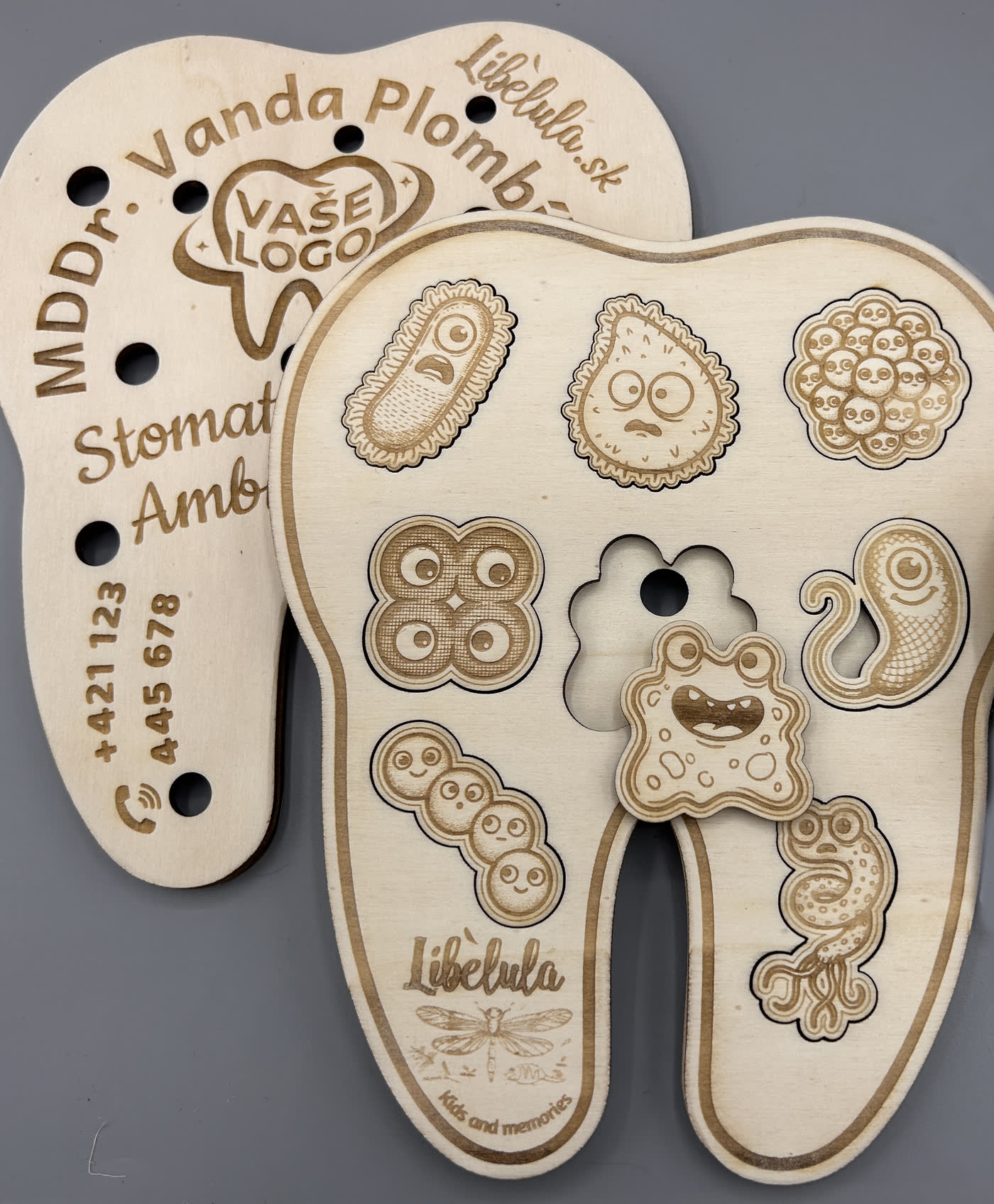
A wooden board cut into the outline of a molar. Inside it, seven recesses, and in each recess a loose piece that lifts out: cartoon bacteria, each one drawn with a face. The child empties the tooth, then puts the bacteria back. That is the whole game, and it is enough — an inset puzzle is the oldest form there is and children under six will do it repeatedly.
Around the tooth, on the frame, is where the practice lives: the dentist's name, the words Stomatologická ambulancia, a telephone number, and space for the practice's own logo. It is engraved into the wood at the same time as the puzzle is cut, in the same pass, so it is not a sticker and there is nothing to peel.
The pieces come with a small drawstring bag. That part is not decoration: a puzzle with seven loose pieces and nowhere to keep them is a puzzle with five pieces by Thursday.
Why a tooth, and why bacteria
The subject was not chosen to be clever. A child who is about to have their teeth looked at is usually a child who is nervous, and the thing they are nervous about is abstract — something bad is happening in a place they cannot see.
A tooth you can take apart makes it concrete. The bacteria have faces, they come out, and they go back in. A parent sitting beside the child has an obvious sentence to say, and most of them say it without being prompted: that is what the dentist takes off your teeth. The toy does the first two minutes of the appointment before the appointment starts.
Where the practice's name actually goes
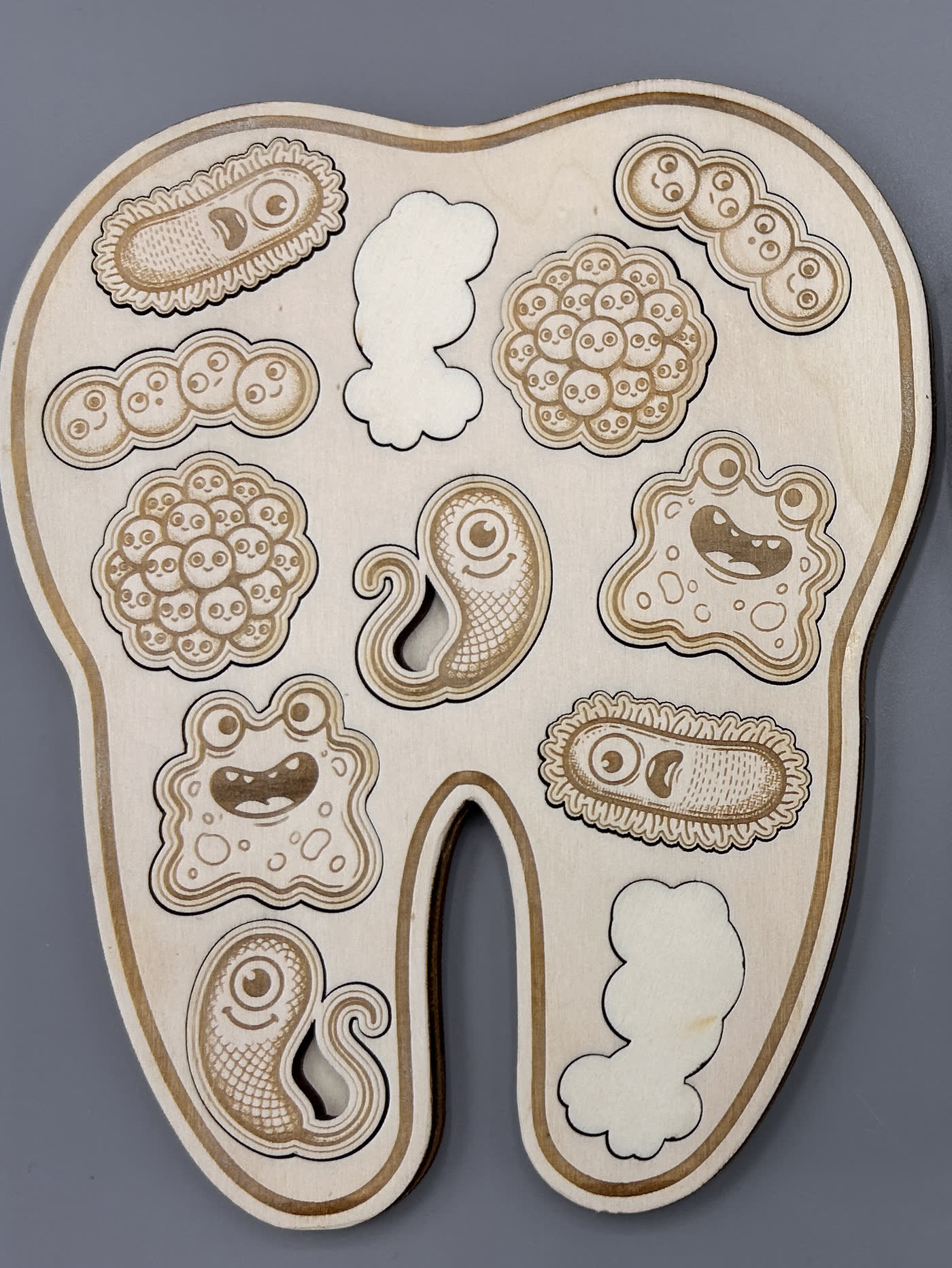
On the frame, not on the pieces. This matters more than it sounds.
The pieces are the part that gets carried around the room, dropped, and occasionally taken home in a pocket. The frame is the part that stays on the table, face up, for the next family. Putting the practice details on the frame means the name is in front of whoever is sitting there, all day, every day — and it means a lost piece costs a piece rather than the whole point of the object.
The engraving depth is the same across the board, so the name reads as clearly as the puzzle does. There is no printing anywhere on it: everything you can see is either cut through the wood or burnt into it.
The arithmetic of a waiting room
Do this with your own appointment book rather than ours, because the numbers are yours.
Count the families with a child who sit in your waiting room in a week. Multiply by the minutes they actually wait — not the minutes your schedule says, the real ones. That figure is how much attention your practice already owns and is currently spending on a water cooler.
Now compare what it costs to put something in front of that attention. A poster is cheap and is looked at once, by the person who notices it on their first visit. A board that a child asks for by name is looked at every visit, by two people, for as long as they are sitting there. Neither of those is a marketing claim — it is just what happens to an object that a child wants to touch versus one that is behind glass on a wall.
The reason we make the point this way is that the number that matters is not the price of the board. It is how many minutes of already-paid-for attention it fills, and only you can count that.
The second board, for the ones who are too young
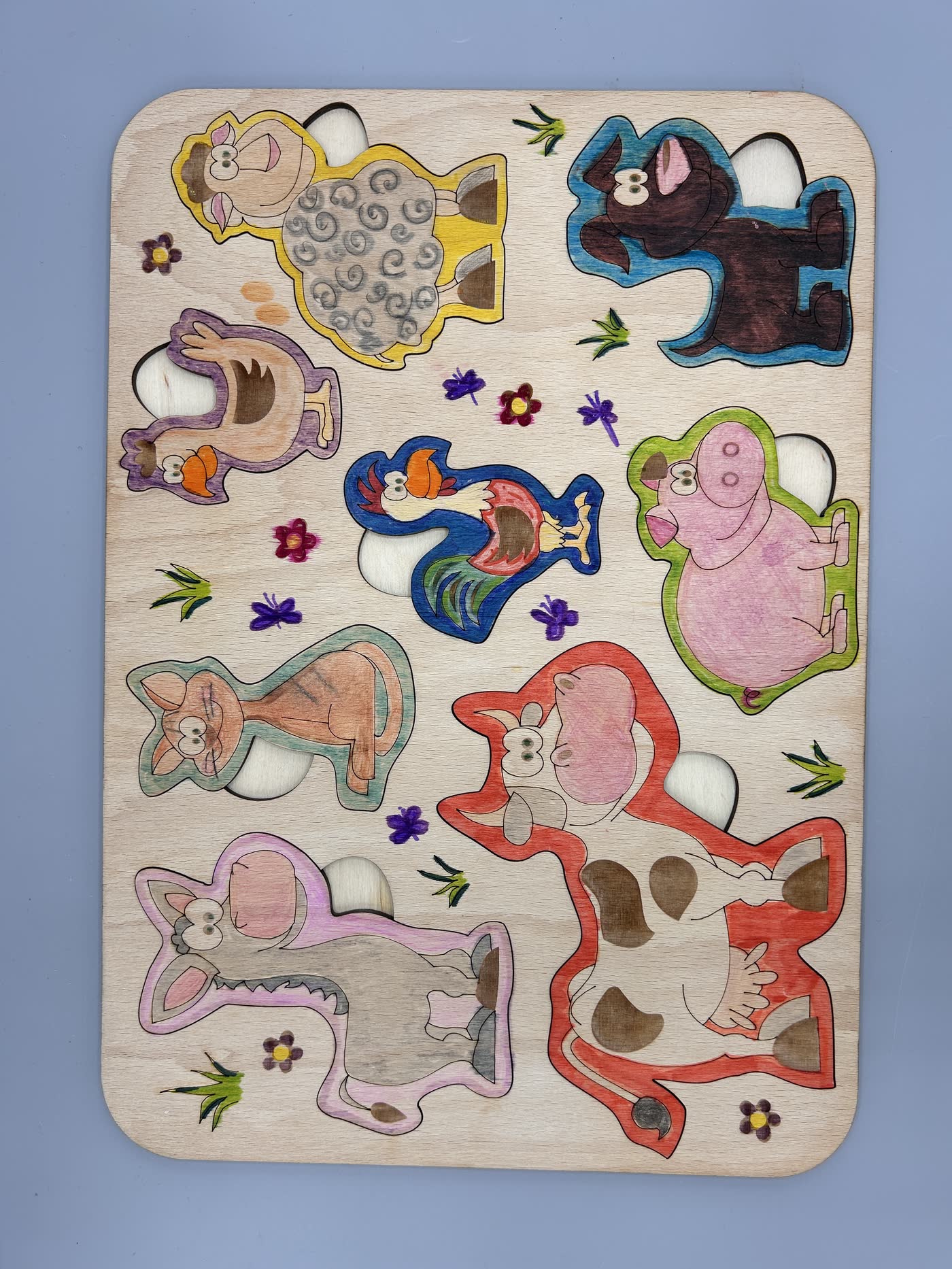
A two-year-old will not do a seven-piece inset puzzle. For a waiting room that sees very young children, the same construction works with simpler shapes — farm animals, each one a single piece in its own recess, large enough to be picked up with a whole hand.
These can be left natural or coloured in. A practice that runs a children's morning sometimes takes them plain and puts crayons out; the boards come back coloured differently every week, which is its own small reason for a family to come back.
What decides the cost
Three things, and none of them is the wood.
Cutting time. Every line in the drawing is time on the laser. Seven bacteria with faces take considerably longer than seven plain circles, and the difference is measured in minutes per board, which turns into hours across an order.
Hand finishing. Every piece is sanded by hand after it comes off the machine — edges, corners, and the inside of every recess. On a board with seven pieces that is fifteen surfaces per unit. It is the part of the process that does not get faster with volume.
Quantity. Setting up a design is the same work whether you order one board or forty. A single personalised board is always going to cost more per unit than a run for a chain of practices, and it is worth asking for both numbers before deciding.
We do not publish a price for these, because a board with your logo on it is not a catalogue item — the drawing has to be prepared for your practice first. Ask, and you get a figure for the quantity you actually want.
The question a dentist always asks
How do you clean it.
The honest answer: bare wood is not a wipe-clean surface. It is sanded smooth and left unfinished, with no plastic and no coating, which is exactly why it feels the way it does — and it is also why you cannot take a disinfectant wipe to it the way you would to a plastic toy.
If your practice needs a surface that can be wiped between patients, say so when you ask. A sealed finish changes the feel and the look, and it is a decision worth making deliberately rather than discovering afterwards. We would rather tell you this before you order than have you find out in week two.
What else fits the same room
The tooth board is the obvious one, but the construction is not limited to it. The same method — one sheet, cut through, engraved, hand-sanded, personalised on the frame — makes a height chart for the wall, a bravery token for a child who sat still, a set of drawing templates for the corner table.
What they have in common is that they are objects a person holds. That is the whole argument for wood in a waiting room: a leaflet is read once if at all, and a thing you pick up is looked at every time you sit down.
It is not only dentists
The construction has nothing dental about it. It is one sheet of plywood, cut through, engraved, sanded by hand, with a personalised frame — and the reason it suits a dental practice is a reason that suits several other rooms just as well.
Veterinary surgeries. The same nervous child, usually holding a carrier, plus an animal subject that draws itself. A dog or a cat inset board with the surgery's name on the frame is the identical object with a different drawing.
Paediatricians and physiotherapists. Longer waits than a dentist, on average, and the same problem: a room full of people who are anxious and have nothing to do with their hands.
Hairdressers and opticians. Not a nervous room, but a slow one, and both are businesses where the customer sits in the same chair every few months and notices what changed.
In each case the argument is the same. You are not buying advertising space — you already own it. You are buying something worth putting in it.
How to order one
Send us the practice name exactly as you want it engraved, a telephone number, and your logo as a file — anything vector is ideal, but a clean image works. Tell us roughly how many boards and whether they are for one room or several.
We prepare the drawing, show you how the engraved panel will look before anything is cut, and make changes at that stage rather than after. Cutting, sanding and engraving happen in our own workshop in Gemer, Slovakia.
Questions we get
Can you put our logo on it, or only text?
Both. The logo is engraved in the same pass as the rest of the board, so it sits in the wood rather than on it. Send it as a vector file if you have one; if you only have an image, send the largest version you have and we will tell you whether it will hold at that size.
How small can the text be and still be readable?
The laser holds detail to a tenth of a millimetre, so the limit is not the machine — it is the wood grain underneath the letters. In practice a phone number reads cleanly at the size you would print it on a business card, and we will tell you if a piece of text is going too small.
Is it safe for small children?
The pieces are hand-sanded until there are no splinters and the wood is left bare, with no paint and no coating. The pieces are small enough to be picked up, which also means small enough to be put in a mouth — the animal boards are the ones to choose for a room that sees toddlers.
Can we order just one to try?
Yes. A single personalised board costs more per unit than a batch, because preparing the drawing is the same work either way, but there is no minimum and no obligation to order more afterwards.
What wood is it?
Plywood, cut from a single sheet so the board and its pieces come out of the same material and match exactly. We will tell you which sheet is going into your run when you order — the thickness changes how deep the recesses sit, and that is worth agreeing before cutting rather than after.
Can we have more than one design in the same room?
Yes, and it is usually the better choice. Two or three boards at different difficulties cover a wider age range than three copies of one, and a family that comes back finds something they have not done. The practice details on the frame stay identical across all of them.
How long does it take?
It depends on what is already on the machine and how many boards you need. Ask when you send the logo and you will get a date rather than a range — we would rather give you one honest date than a comfortable estimate.
The point of the room
A waiting room is not empty time. It is the only part of the visit where a patient is sitting still with nothing to do, and it is the part every practice furnishes last.
Something a child wants to touch, with your name cut into the frame of it, does more work in that room than the poster above it ever has.
Ready to send one?
Choose a ready-made box or build your own — engraved with your logo or a name.