A wooden wedding cake topper is a shape cut from a single sheet of plywood on a spike: a couple's silhouette, a laurel wreath, initials, or a name and date. It arrives as bare wood, it survives the day intact, and unlike a sugar or acrylic topper it is still an object a year later.
The cake topper is almost always the last decision. The cake is ordered, the flowers are chosen, and then somebody realises there is nothing going on the top of it — usually about three weeks out.
Which is a shame, because it is in every photograph of the cake, and it is one of the very few things from the day that keeps existing afterwards.
Three kinds, and what each one is good at
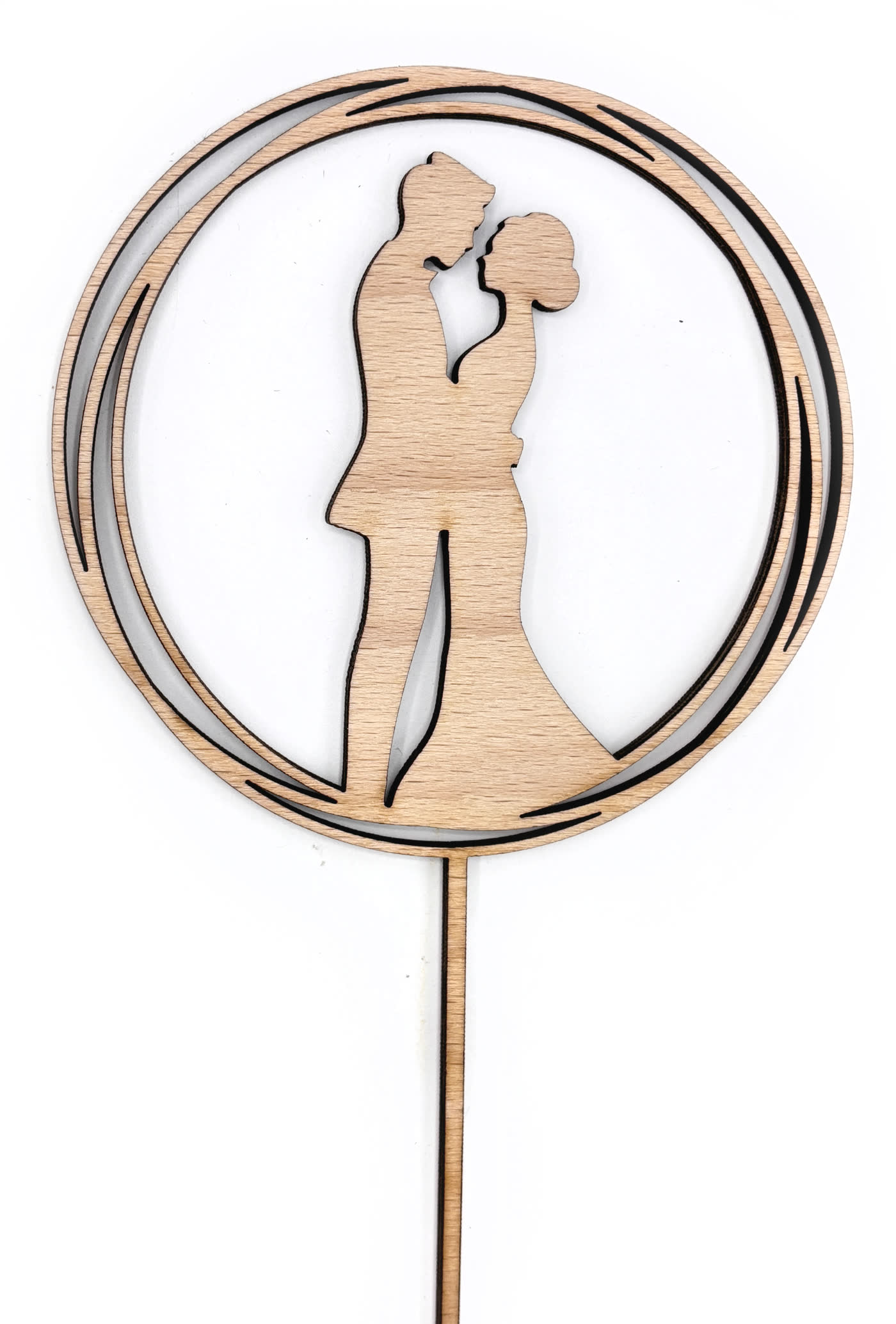
A silhouette. Two figures, usually inside a ring or a wreath. It reads from across a room, photographs cleanly against any cake colour, and it does not date. This is the one to choose if the cake is the centre of the room rather than a detail at the side.
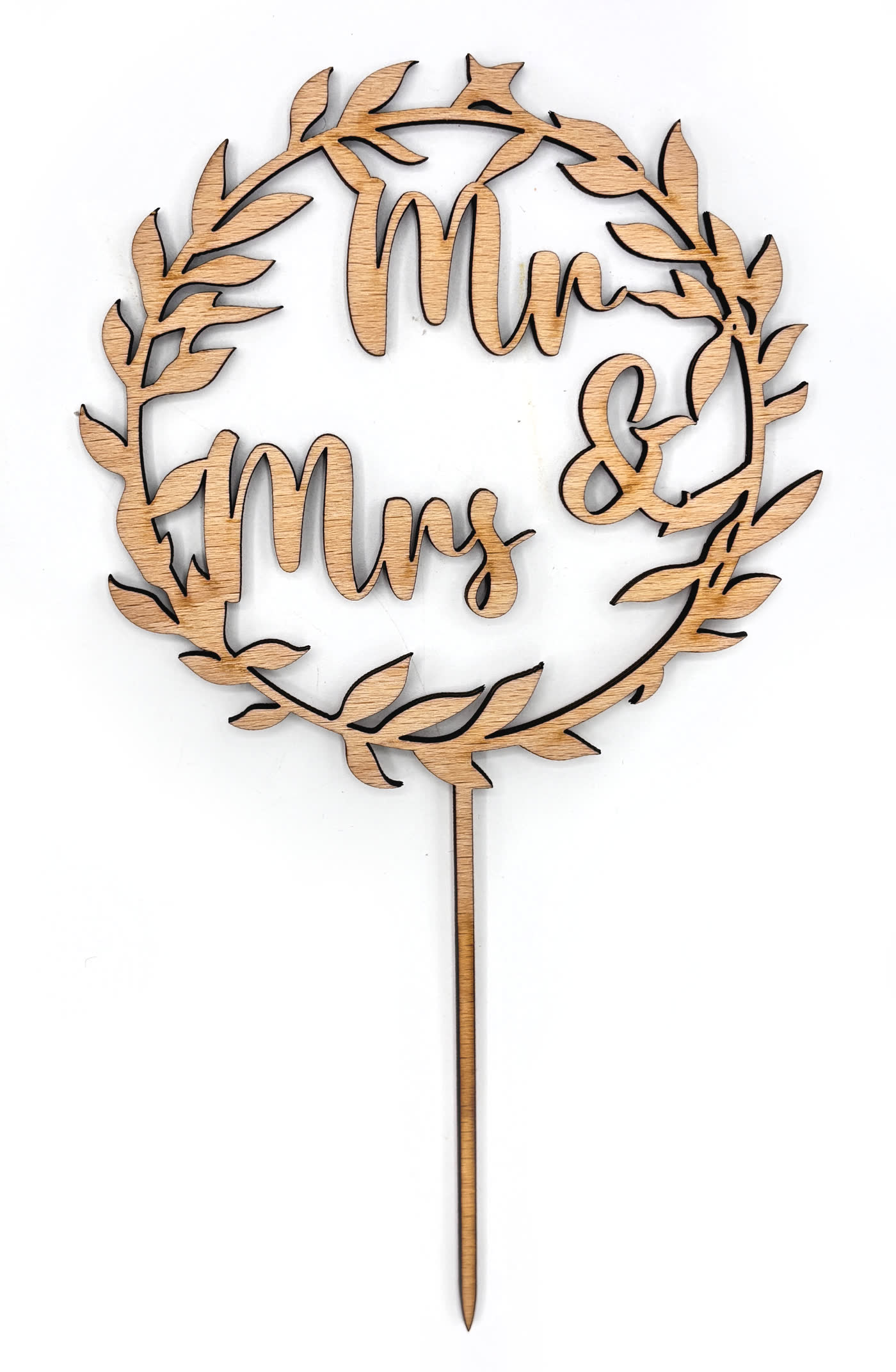
Words. Mr & Mrs, two names, or a date, cut as a single connected piece. It says something specific, which a silhouette does not — and it is the version people keep on a shelf afterwards, because a name is a reason to keep something.
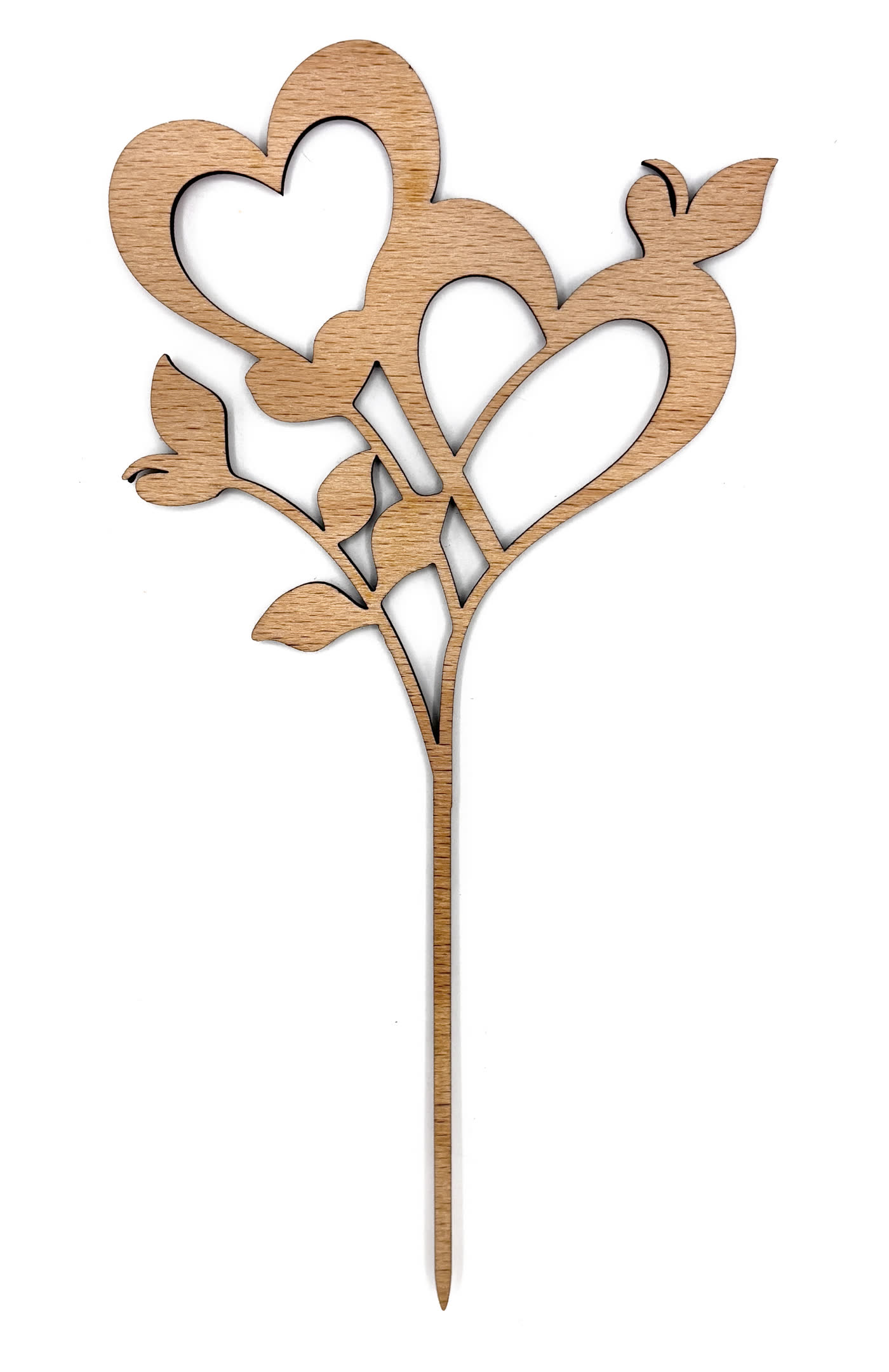
A motif. Hearts, branches, a wreath with nothing inside it. The quietest of the three and the one that suits a cake that is already doing a lot: heavy flowers, strong colour, a lot of texture. A busy cake with a busy topper is two things competing.
The combination that works least often is a silhouette and a long phrase. The eye reads one or the other, and at the size a topper actually is, both means neither.
What the photographs actually need
Almost every decision about a topper is really a decision about one photograph: the cake, shot straight on, usually in a room that is darker than anyone expects.
Three things help that photograph, and they are all choices made before the day. Contrast against the icing. Pale wood on white icing is a soft, quiet picture; the same topper on a dark cake is a strong one. Neither is wrong, but they are different photographs and it is worth knowing which you are choosing. Negative space. A design with gaps cut through it — a ring, a wreath, letters with air around them — lets the cake show through and stops the topper reading as a solid blob at a distance. A silhouette that survives being small. In a wide shot of the room, the topper is a centimetre tall. Fine internal detail disappears entirely; outline is all that is left.
If you only take one thing from this section: choose the shape that still reads when you squint at it.
The sizing mistake almost everyone makes
Toppers are sold by their own dimensions and chosen by looking at a photograph, and neither of those tells you whether it will work on your cake.
The number that matters is the diameter of the top tier — not the cake, the top tier. A topper wider than that tier hangs over the edge and looks like it landed there. A topper much narrower than it looks lost, with a ring of empty icing around it.
As a working rule, the topper should be somewhere between half and three-quarters of the top tier's width. On a 15 cm top tier that is roughly 8–11 cm across. Taller is more forgiving than wider: height reads as elegance, width reads as a mistake.
Ask your baker for the top tier's diameter before you order anything. It is one message, and it is the difference between a topper that looks made for the cake and one that looks bought separately.
The height question
The second measurement, and the one nobody thinks of: how tall the topper is above the icing, and how much of the spike disappears into it.
A spike that is too short will not hold — the topper leans, usually towards the camera, and once it has leaned it stays leaned. A spike that is too long goes through the top tier into the board and lifts the whole thing when it is pushed in.
Tell us the height of your top tier when you order and the spike gets cut to suit it. It costs nothing and it is the single most common reason a topper does not sit straight in the photographs.
Wood or acrylic
Acrylic is the other thing you will be shown, usually mirrored gold or rose gold, and it is not a bad option — it is bright, it is cheap, and it photographs with a flash beautifully.
What it does not do is any of the following. It does not have grain, so every acrylic topper looks like every other acrylic topper. It does not go quiet: a mirrored surface reflects whatever is around it, including the photographer. And it is not an object afterwards — a plastic offcut on a shelf is a plastic offcut on a shelf.
Wood is warmer in a photograph, matches a rustic or garden setting without trying, and reads against both white icing and dark chocolate. It is also the one you can hand to a child in twenty years without explaining what it is.
The food-contact question, answered honestly
This is the part most sellers of wooden toppers do not mention, so we will.
Bare wood is not a food-contact material. It is porous, it is not sealed, and although it is sanded smooth and has nothing on it — no varnish, no paint, no coating — that is exactly the point: there is no barrier between the wood and the cake.
What people do, and what we would advise: wrap the part of the spike that goes into the cake in a small piece of foil or clear film before pushing it in. It takes ten seconds, it is invisible once the topper is in place, and it settles the question. Many bakers do this as a matter of course without being asked.
The alternative is to place the topper into a flower or a piece of decoration on the top tier rather than into the icing itself, which is how a lot of florists set them anyway.
Names, dates, and what to leave off
Two first names and a date is the version that ages best. Surnames are what change; first names and the day do not.
If you want a phrase, keep it to three or four words. A cut phrase has to stay connected — every letter must touch its neighbours or the frame, or it falls out of the sheet — and a long sentence becomes a dense tangle at topper size. Short reads; long becomes texture.
We show you the drawing before anything is cut, at the actual size, so you can see the words as they will be rather than as you imagine them. Changes at that stage are free and take a minute.
If there is more than one cake
Two cakes, or a cake and a dessert table, is more common than it used to be, and it changes the answer.
Matching toppers on both looks repetitive; ignoring the second cake looks unfinished. What works is one full topper — names, date, the piece people photograph — and a smaller, simpler piece from the same drawing on the second: the wreath without the names in it, or a single heart from the same motif. They are recognisably the same family without being the same object.
Cut at the same time, a second small piece costs very little, because the setup is already done and the sheet is already on the bed. It is much cheaper to add now than to order separately in three weeks when someone notices the dessert table is bare.
Ordering it in time
A topper is a small object and it is tempting to leave it late. Two things make late expensive.
The first is the drawing. A personalised topper needs the names set, cut, and checked by you before it goes on the machine, and that conversation is a day or two even when everyone is quick.
The second is post. A cake topper is light and awkward, and light awkward parcels are exactly the kind that arrive on the wrong day. Order with a fortnight in hand and the delivery date stops being a thing you think about.
If you are inside a week, ask anyway — sometimes it is genuinely possible, and we would rather tell you honestly that it is not than take the order and hope.
Afterwards
A sugar topper is eaten. An acrylic one goes in a drawer. A wooden one, with two names and a date cut through it, tends to end up on a shelf or in a frame — and it is the only piece of the day, apart from the rings and the photographs, that survives in the form it had.
Some people ask us to cut a second one at the same time, identical, for a parent. It is the same drawing and almost no extra work, and it is the sort of thing that is much easier to do on the day you order than a year later.
Questions we get
How big should it be?
Between half and three-quarters of the width of the top tier — not the whole cake. On a 15 cm top tier that is about 8–11 cm across. Send us the top tier's diameter and we will size it for you rather than leaving you to guess from a photograph.
Is it safe to put into the cake?
Bare wood is not a food-contact material, so wrap the spike in a small piece of foil or clear film before it goes in. It takes seconds and is invisible once the topper is standing. Your baker may well do this without being asked.
Can we have our own drawing?
Yes. Line art works, silhouettes work, and anything with a clean outline works. What does not is a photograph or a soft gradient — a topper is cut, not printed, so the drawing has to be shapes rather than tones. Send what you have and we will tell you honestly whether it will cut.
Will the names hold together?
They have to, and that is a drawing problem rather than a machine one: every letter must connect to something. Script fonts do this naturally; a widely spaced serif does not. We will show you the drawing at real size and, if a letter is floating, redraw it before cutting rather than after.
What if the wood colour clashes with our cake?
Bare plywood is pale and warm, and it sits well against white, ivory, blush and dark chocolate. It fights with grey and with cool blue-white icing. If your cake is either of those, ask — a stained sheet is possible and changes the whole feel.
Can you make one to match our invitations?
Often, yes. Send the invitation as a file or a photograph; if the motif on it is line work, it can usually be cut. This is the most common request we get from couples who have already chosen their stationery, and it is the one that makes a cake look planned rather than assembled.
Where they are made
Every topper is cut from a single sheet, sanded by hand until the edges are smooth and splinter-free, and left bare — in our own workshop in Gemer, Slovakia. The file is kept, so a second one, later, is the same drawing rather than a near match.
Ready to send one?
Choose a ready-made box or build your own — engraved with your logo or a name.