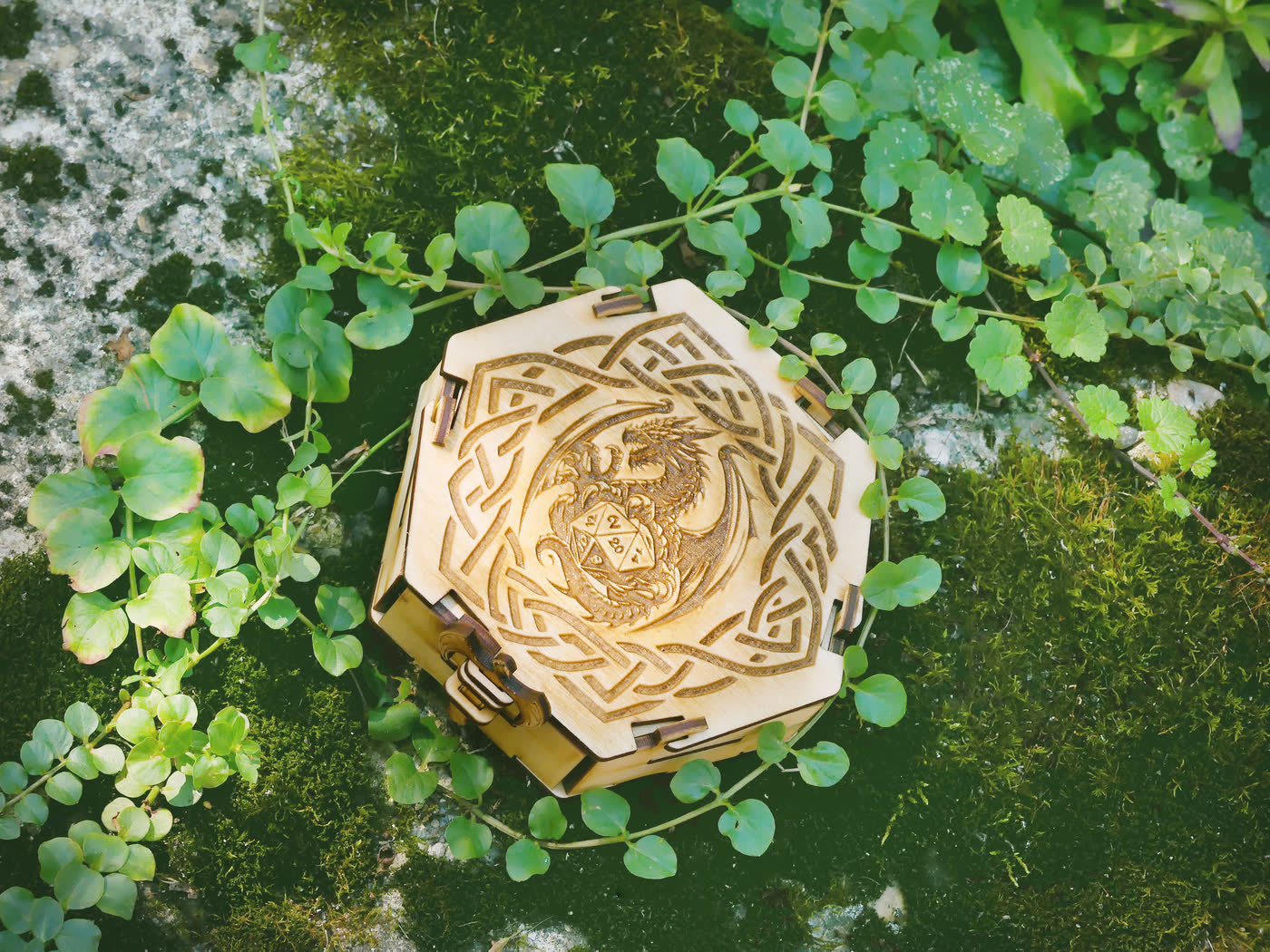
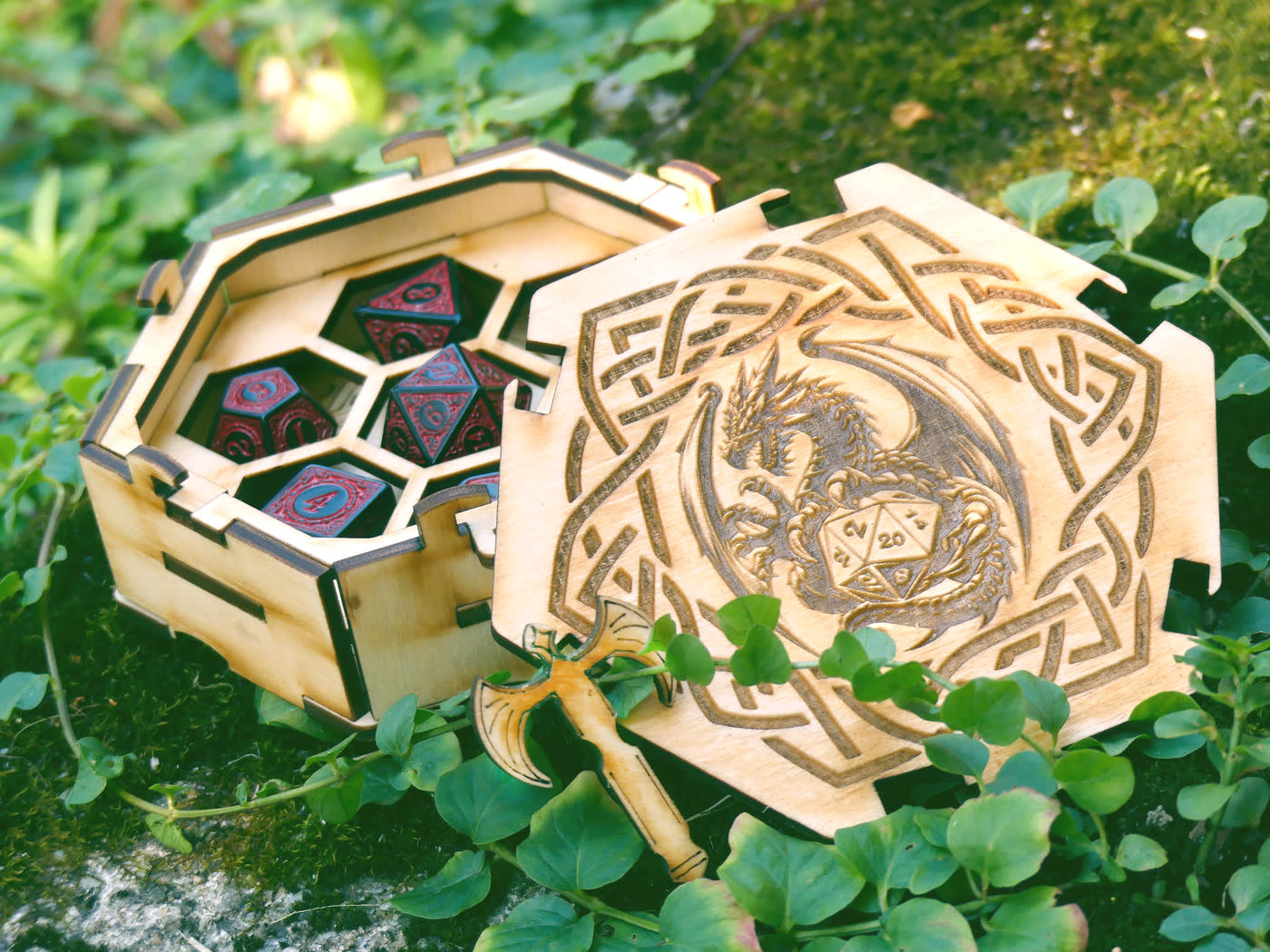
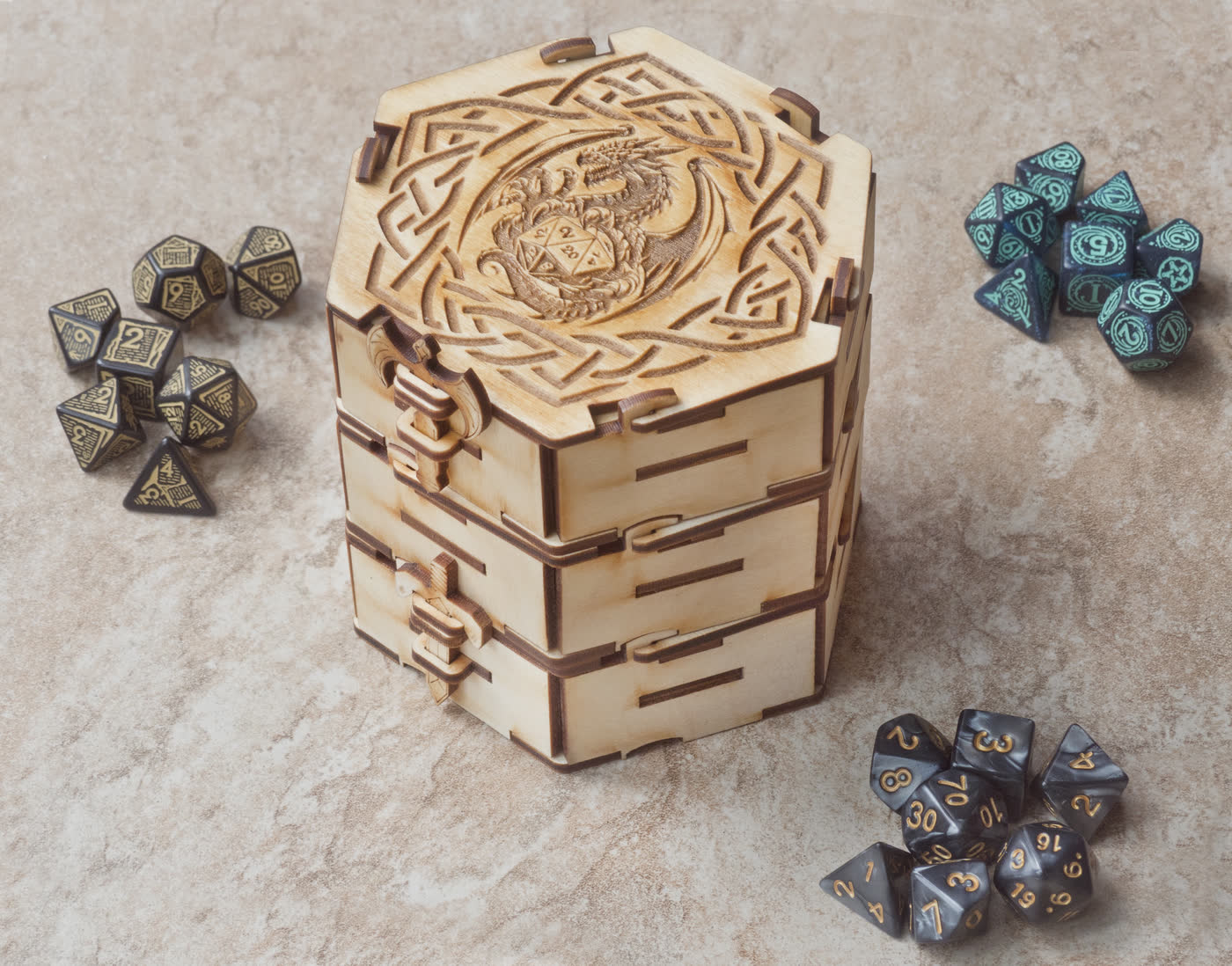
This is a laser-cut hexagonal box with a honeycomb insert: seven cells, one for each die in a standard polyhedral set, so nothing rattles and nothing chips. The lid carries a dragon coiled around a d20 inside a Celtic knot border, and because the outline is a hexagon, several boxes stack into a tower.
Most dice boxes are a rectangle with felt in the bottom. Your dice go in, they slide around, and the d4 finds the d20 every time you pick the box up. It works, in the sense that the dice are contained.
We wanted the other thing — a box where every die has a place, and where owning three boxes is better than owning three boxes.
The thing about buying dice accessories
There is a specific disappointment familiar to anyone who has bought one. The photograph shows a box on moss, lit from the side, and what arrives is thinner than it looked, the engraving is a scratch rather than a carving, and the hinge is a strip of leatherette stapled on.
The reason is that a dice box is an easy thing to make badly. The shape is simple, the market will pay for a picture, and almost all of the cost sits in the parts a photograph does not show: depth of cut, sanding time, and hardware that is metal.
So the useful questions when you are looking at any dice box — ours or anyone's — are these. Is the engraving relief or outline? Is the hinge metal? Does the interior have cells, or is it a box with felt? And is there a photograph of the inside, or only of the lid? A maker who is proud of the interior photographs the interior.
Why hexagonal
Because the hexagon is the only regular shape that tiles a plane with no gaps, which is exactly the problem a dice box has.
Put round sockets in a square box and the space between them is wasted — four little triangles per socket, doing nothing but making the box bigger. Arrange the same sockets in a honeycomb and the walls between them are shared. Every die gets a full-depth cell, and the box that holds them is as small as it can be.
The bees worked this out first. We are not claiming originality; we are claiming that it is the right answer and most dice boxes ignore it because a rectangle is easier to make.
Seven cells, seven dice
A standard polyhedral set is d4, d6, d8, two d10s, d12 and d20. Seven dice. Seven cells, cut to sit each one below the rim so the lid closes on air rather than on the dice.
Two consequences, both of which you notice within a week. The box does not rattle when you carry it, which matters more than it sounds when the box lives in a rucksack alongside a laptop. And your dice stop chipping — a resin d4 that spends two years knocking against a metal d20 loses its points, and the cells are what stops that.
There is also the smaller pleasure of putting them away. Seven dice into seven holes is a satisfying end to a session in a way that tipping them into a bag is not.
The lid
A dragon coiled around a d20, inside a Celtic knot border that runs the full hexagon.
Knotwork and laser engraving suit each other for a specific reason: knotwork is a single line that never ends, crossing over and under itself, and depth is exactly what tells the eye which strand is on top. Printed knotwork needs shading to fake that. Cut knotwork simply has it — the over-strand is physically higher than the under-strand, and the shadow does the rest.
The dragon is relief-engraved rather than outlined, so the wing membranes sit lower than the bones and the d20 it is holding reads as a solid object rather than a shape. It is the part of the box that takes the longest to cut, and it is the part you look at every session.
Metal where metal belongs
The clasp and the hinges are brass, not wood.
Wooden hinges exist and they look clever in a photograph. They also wear, because a hinge is a bearing and wood is a poor bearing — the hole becomes an oval and the lid starts to sit crooked. On a box that gets opened twice a week for years, that is not a theoretical problem.
The clasp matters for a different reason: a dice box that opens in a bag is a dice box that has failed at its one job. A friction lid is fine on a shelf and unreliable in transit.
Stacking
This is the part that changes what the box is for.
Because every box is the same hexagon, they sit on top of each other squarely — the footprint of one is the footprint of five. Anyone who has played for more than a year has more than one set, and usually keeps them in a drawer because a shelf full of mismatched boxes looks like a shelf full of mismatched boxes.
A stack of hexagons looks deliberate. It also means the sets stay separated: your campaign dice, the set you lend out, and the one you do not let anyone else touch, each in its own layer, in a column that takes up one box of shelf.
What it does not do
It is not a rolling tray. The cells are the whole point of the interior, and there is no flat felt surface to roll on. If you want a box that opens into a tray, that is a genuinely different object and you should buy that one.
It is not waterproof, and it is not a drop case. It is wood, hand-sanded and left bare, and it will mark. Most people find that the marks are the point after a year or two, but it is worth knowing before rather than after.
It will not hold oversized or metal dice at full depth. A standard resin set fits. A chunky metal d20 may sit slightly proud, which the lid will accommodate but the cell was not cut for. Ask before ordering if your set is unusual — we would rather measure than guess.
Personalising it
The lid has room around the dragon for a name, and that is where most people put one.
A character name is the obvious choice and the one that ages best — the campaign ends, the character does not stop having existed. A party name works for a set bought together, and matching boxes across a table is its own quiet joke. A date suits a box given as a gift, which is what most of these are.
What we would gently steer you away from is a long quote. The border is dense and knotwork does not leave much quiet field; a short line reads, and a sentence becomes texture. We will show you the engraved panel before cutting so you can see it rather than imagine it.
How it is made
One sheet of plywood, cut on a laser, in our own workshop in Gemer, Slovakia.
The panels are cut first, then the honeycomb insert, then the lid is engraved in several passes of different depth — that is what produces the relief rather than an outline. After the machine stops, every piece is sanded by hand: the outer faces, the edges, and the inside of all seven cells. That last part is most of the finishing time and it is the reason the box feels the way it does when you put a die in.
The wood is left bare. No varnish, no lacquer, nothing between your hand and the material.
Giving one
Most of these are bought as gifts, and it is a slightly awkward gift to buy, because the person receiving it has opinions about dice.
Two things make it land. Do not put dice in it. The temptation is to fill the cells, and it is almost always wrong — a player who cares enough to want a box already has the set they want in it. An empty box says this is for the ones you already love; a full one says I chose these for you, which is a different and riskier sentence.
Put the character name on it, not theirs. A box with someone's own name engraved on it is a nice object. A box with the name of the half-elf they have been playing since 2023 is a different order of gift, because it says you were listening.
If you do not know the character's name and cannot ask without ruining it, a date works, and nothing at all works too. A blank lid with the dragon on it is not a lesser object — it is one they can decide about later.
Questions we get
Will it fit my dice?
A standard resin polyhedral set fits with room to spare. Metal dice are heavier and often fractionally larger; oversized d20s vary a lot between makers. If your set is unusual, send us the diameter of the largest die and we will tell you honestly whether it will sit flush.
Can I get more than seven cells?
The insert is cut to a drawing, so yes — a fourteen-cell version for two sets, or a layout with one larger cell for a token or a ring, is a change to the file rather than a new product. Tell us what you want to keep in it.
Does the lid stay shut in a bag?
That is what the brass clasp is for. A friction lid is fine on a table and unreliable in a rucksack, which is why this one has a catch rather than a fit.
Can I have a different creature on the lid?
Yes. The dragon is our drawing, but the lid is a panel and the panel can carry anything that engraves well — a sigil, a class symbol, a crest. Line art and high-contrast subjects work best; photographs and soft gradients do not.
How many boxes stack safely?
As many as you can reach. They are hexagons of the same size sitting on each other, not an interlocking system, so a tall stack will slide if the shelf is knocked. Four or five is a stack; ten is a balancing act.
Will it survive being carried to a game every week?
That is what the brass hardware is for, and it is the reason we do not use wooden hinges. What will not survive indefinitely is the surface: bare wood in a rucksack picks up marks from keys, zips and everything else in there. The box keeps working; it stops looking new, fairly quickly.
Can two people at the same table have matching ones?
Yes, and it is the most common repeat order we get. We keep the file, so a second box cut months later is the same drawing at the same depth rather than a near match — and the two lids can carry different names inside an identical border.
Is it finished with anything?
No. Bare, hand-sanded wood. If you want it oiled you can do that yourself — a hard wax oil is the usual choice — but be aware it will darken the wood and slightly reduce the contrast in the engraving, which is why we do not do it by default.
Who it is for
Someone who already has dice they care about. Nobody buys a box like this for their first set — they buy it for the set they have been rolling for three years, or for the person at the table who still keeps theirs in the tin the set came in.
Cut, sanded and engraved by hand in Gemer, Slovakia, and the file is kept — so if you come back for a second box for the same party, it matches the first.
Ready to send one?
Choose a ready-made box or build your own — engraved with your logo or a name.